Natural wonders inspire active nature career
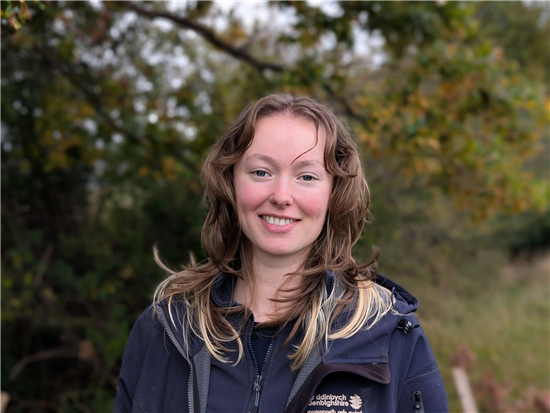
A love of animals from a young age and an inspiration from a teacher who supported nature in the Galapagos has helped shape a career that now protects and preserves Denbighshire’s biodiversity.
Ellie Wainwright is part of the Council’s Biodiversity Team who are hard at work all year supporting existing nature in the county, establishing new habitats to help local wildlife thrive and survive, and helping educate all ages towards what they can do to protect their own biodiversity.
County Voice sat down with Ellie to find out the inspiration that has carried her through a career full of experiences helping nature across the UK.
Ellie said: “I grew up near a lake in a small town in Northamptonshire. Seasonally the baby frogs would come up through our garden in late summer, after leaving the lake, and I have memories of me and my brother going out and making frog hotels and handling them.
“So, I’ve always loved animals, but I had no idea what I wanted to do as a job until I reached sixth form. I did Human Biology as one of my A-levels and amazingly one of my teachers happened to be a conservationist.
“He’d worked for Operation Wallacea in the Galapagos Islands which is a really cool organisation running biodiversity research expeditions all over the world, I believe he was researching turtles. That was the first time I realised that you could do this as a career, I decided that’s what I wanted to do and started looking into universities that offered ecology and conservation courses.”
To support the career, she’d set her eyes on, Ellie swiftly set about volunteering at the weekends as well with the local Wildlife Trust group to her home to gain valuable experience whilst working in one of their woodlands.
Using her volunteer experience, she embarked on a wildlife conservation degree at the University of Kent.
Ellie explained: “It was a really good course, where I learnt a lot about conservation theory. My favourite modules were probably Evolutionary Biology and Genetics, and Behaviour Change. A lot of the lectures used examples from tropical ecosystems as a lot of my lecturers had lived abroad and done work with species in Madagascar, Mauritius, and Borneo.
“Although we did have one lecturer who did a lot of work with UK reptile and amphibian species, which is more closely related to my work now.”
Between her second and third year for professional practice experience, Ellie spent time adding elements of Zoology to her learning by working with Durrel Wildlife Conservation Trust at Jersey Zoo.
She said: “I worked as a placement student/trainee zookeeper, in the bird department for five months and for the rest I was on the mammal department and that was really fun. It was fascinating learning about all the different species and how they keep and breed them for different conservation projects around the world.”
Finishing University, Ellie found herself making her first steps into the landscape of Denbighshire to discover the county’s nature.
She explained: “I applied for a job as an assistant countryside ranger with the Clwydian Range and Dee Valley AONB which was three days a week post. I moved up to live in a house share in Wrexham and very quickly the role was expanded to five days a week.
“I worked with the Nature for Health Project which is such a nice project for engaging with people outdoors to help their physical and mental health. I always tried to bring biodiversity into this work as much as I could. As well as activities such as mindfulness and arts and crafts, I also tried to get people to get involved in things like bat surveys.”
After working with Nature for Health, Ellie became a permanent ranger with the AONB working outdoors around the Llangollen and Dee Valley areas, during which she tackled the difficult period of monitoring sites such as the Horseshoe Falls during the Covid Pandemic and the many introduced regulations the public had to follow.
Through all of this, volunteering was still providing new challenges and discoveries for Ellie, which helped her move further forward into the biodiversity career she carried out today for Denbighshire County Council.
She said: “I’d been doing a lot of volunteer wildlife surveys around my post over the years I was there; I’d been going out with the Clwyd Bat Group and the North Wales Mammal Group. As well as helping with great crested newt surveys with the Wrexham rangers at one of their sites and through work as well.”
Linking in with the North Wales Mammal Group allowed her to take part in studying the Nathusius’ pipistrelle bat using safe and humane bat trapping methods to look at how they migrate.
“It was great because there were some very knowledgeable people running it. You'd get to identify the bats close up which was fascinating, I learnt a lot. At one point I was releasing a tiny Pipistrelle bat, who had clearly got quite warm on my hands and didn't want to leave.”
Through this experience Ellie moved into an assistant biodiversity officer role for Flintshire County Council.
Ellie added: “I learnt a lot there, it’s very different from Denbighshire as there are more urban areas… I got really involved with their wildflower project and was able to carry out a lot more nature and wildlife surveys in that role, which was great experience.”
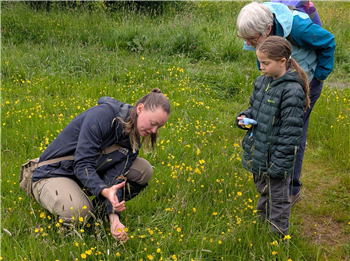
Stepping into her current role as biodiversity officer, it’s evident that the passion for protecting nature is burning bright.
She explained: “I love getting out on surveys and seeing these species that we are trying to save and create more habitat for. It really focuses you on why you are doing this role and for me…its so good for my own mental health
“Every time I see a frog; I get really happy. The first time I saw a sand lizard, I was ecstatic. I've seen my first dormouse as well in this job.
“The Wildflower Project is fantastic; it's one of the best conservation projects I think that any local authority can do. A simple change to the way the council manages it’s grassland areas, can result in such a big payoff for wildlife.
“I think it's made a real difference across the county, we've converted all 1820km of the rural road verge network to long grass/wildflower habitat over the summer. As well as over 60 acres of urban verges and greenspaces to wildflower meadow and they've all improved in species diversity.
Ellie added: “Because we’ve been carrying out wildflower surveys on the sites every growing season since the project began in 2020, we can definitively say that all of the urban sites have increased in plant species diversity – some quite significantly! I love feeling like I’m making a difference for biodiversity and seeing positive impacts from our work. It makes me feel like I am I am doing my part to address the biodiversity crisis and the climate change crisis.”
Currently keeping Ellie and her colleagues busy is the creation of the 70-acre Green Gates Nature Reserve which already contains the successful local provenance tree and wildflower nursery the Biodiversity Team have helped establish.
Ellie explained: “It's been a while in the making, but I think we’ve created a really valuable habitat for wildlife. You walk around the site now and it’s buzzing with life, we've spotted kingfishers, we've had eels in the stream. I see kestrels and buzzards hunting over the rough grassland, and we've seen three grass snakes this summer.
“We've installed over 20 ponds on site, all of which are starting to green up. Now we've had different aquatic plant species starting to pop through, and we've recorded frogspawn and some smooth newts in a couple of the brand-new ones as well. We have recorded great crested newts on site before, and we expect this will be a really important site for them going forward.”
Thousands of trees grown from seeds sourced locally by Ellie and the Biodiversity Team have also been planted out on the site, and preparations are underway for hopefully two or more new special residents at the reserve next year.
She added: “We’ve been working in the background on the Denbighshire Beaver Project, to assess if it would be feasible and learn about the species. I was very lucky and got to go to Bavaria with the North Wales Wildlife Trust and the Beaver Trust to see beaver habitats in person. It was fascinating to learn about all the different ways that they manage beavers in Bavaria since they were reintroduced in the 1960’s, and what could be applied now that they are back in Britain. Now, we're a lot closer to releasing them into the enclosure on site.
The team are currently working on a licence application to home the beavers in the created enclosure and all being well would look to bring the new residents in after summer 2026.
With so much experienced in nature and wildlife so far in her career, Ellie’s hopeful that more people will follow in her footsteps to provide the help our environment needs.
She said: “Anyone who wants to get into the conservation field, I would say you pretty much have to have a degree nowadays. So doing some sort of formal education is a good idea. And… volunteer, volunteer, volunteer. You just want to get experience doing as much as possible and you want to try as much as possible so you know exactly what you want to go into in this field.
“I did three years of practical conservation work which is brilliant if you want to get stuck in and you want to see the difference you're making as you do it on the ground. There are so many different paths that you can take. Try all of them, do a little bit of each and see what you like.”