FEATURES
Natural wonders inspire active nature career
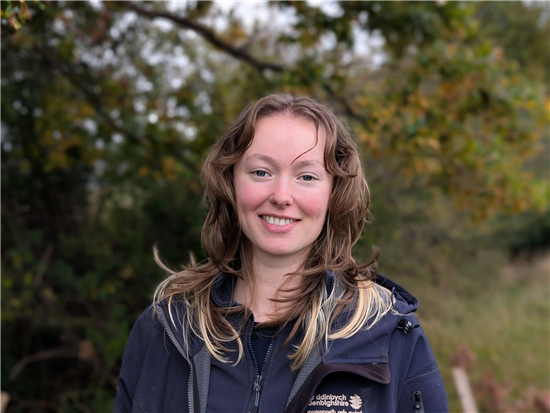
A love of animals from a young age and an inspiration from a teacher who supported nature in the Galapagos has helped shape a career that now protects and preserves Denbighshire’s biodiversity.
Ellie Wainwright is part of the Council’s Biodiversity Team who are hard at work all year supporting existing nature in the county, establishing new habitats to help local wildlife thrive and survive, and helping educate all ages towards what they can do to protect their own biodiversity.
County Voice sat down with Ellie to find out the inspiration that has carried her through a career full of experiences helping nature across the UK.
Ellie said: “I grew up near a lake in a small town in Northamptonshire. Seasonally the baby frogs would come up through our garden in late summer, after leaving the lake, and I have memories of me and my brother going out and making frog hotels and handling them.
“So, I’ve always loved animals, but I had no idea what I wanted to do as a job until I reached sixth form. I did Human Biology as one of my A-levels and amazingly one of my teachers happened to be a conservationist.
“He’d worked for Operation Wallacea in the Galapagos Islands which is a really cool organisation running biodiversity research expeditions all over the world, I believe he was researching turtles. That was the first time I realised that you could do this as a career, I decided that’s what I wanted to do and started looking into universities that offered ecology and conservation courses.”
To support the career, she’d set her eyes on, Ellie swiftly set about volunteering at the weekends as well with the local Wildlife Trust group to her home to gain valuable experience whilst working in one of their woodlands.
Using her volunteer experience, she embarked on a wildlife conservation degree at the University of Kent.
Ellie explained: “It was a really good course, where I learnt a lot about conservation theory. My favourite modules were probably Evolutionary Biology and Genetics, and Behaviour Change. A lot of the lectures used examples from tropical ecosystems as a lot of my lecturers had lived abroad and done work with species in Madagascar, Mauritius, and Borneo.
“Although we did have one lecturer who did a lot of work with UK reptile and amphibian species, which is more closely related to my work now.”
Between her second and third year for professional practice experience, Ellie spent time adding elements of Zoology to her learning by working with Durrel Wildlife Conservation Trust at Jersey Zoo.
She said: “I worked as a placement student/trainee zookeeper, in the bird department for five months and for the rest I was on the mammal department and that was really fun. It was fascinating learning about all the different species and how they keep and breed them for different conservation projects around the world.”
Finishing University, Ellie found herself making her first steps into the landscape of Denbighshire to discover the county’s nature.
She explained: “I applied for a job as an assistant countryside ranger with the Clwydian Range and Dee Valley AONB which was three days a week post. I moved up to live in a house share in Wrexham and very quickly the role was expanded to five days a week.
“I worked with the Nature for Health Project which is such a nice project for engaging with people outdoors to help their physical and mental health. I always tried to bring biodiversity into this work as much as I could. As well as activities such as mindfulness and arts and crafts, I also tried to get people to get involved in things like bat surveys.”
After working with Nature for Health, Ellie became a permanent ranger with the AONB working outdoors around the Llangollen and Dee Valley areas, during which she tackled the difficult period of monitoring sites such as the Horseshoe Falls during the Covid Pandemic and the many introduced regulations the public had to follow.
Through all of this, volunteering was still providing new challenges and discoveries for Ellie, which helped her move further forward into the biodiversity career she carried out today for Denbighshire County Council.
She said: “I’d been doing a lot of volunteer wildlife surveys around my post over the years I was there; I’d been going out with the Clwyd Bat Group and the North Wales Mammal Group. As well as helping with great crested newt surveys with the Wrexham rangers at one of their sites and through work as well.”
Linking in with the North Wales Mammal Group allowed her to take part in studying the Nathusius’ pipistrelle bat using safe and humane bat trapping methods to look at how they migrate.
“It was great because there were some very knowledgeable people running it. You'd get to identify the bats close up which was fascinating, I learnt a lot. At one point I was releasing a tiny Pipistrelle bat, who had clearly got quite warm on my hands and didn't want to leave.”
Through this experience Ellie moved into an assistant biodiversity officer role for Flintshire County Council.
Ellie added: “I learnt a lot there, it’s very different from Denbighshire as there are more urban areas… I got really involved with their wildflower project and was able to carry out a lot more nature and wildlife surveys in that role, which was great experience.”
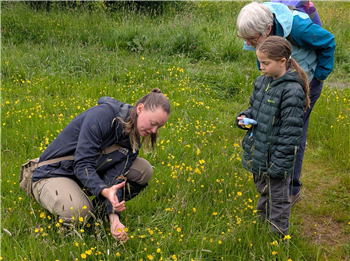
Stepping into her current role as biodiversity officer, it’s evident that the passion for protecting nature is burning bright.
She explained: “I love getting out on surveys and seeing these species that we are trying to save and create more habitat for. It really focuses you on why you are doing this role and for me…its so good for my own mental health
“Every time I see a frog; I get really happy. The first time I saw a sand lizard, I was ecstatic. I've seen my first dormouse as well in this job.
“The Wildflower Project is fantastic; it's one of the best conservation projects I think that any local authority can do. A simple change to the way the council manages it’s grassland areas, can result in such a big payoff for wildlife.
“I think it's made a real difference across the county, we've converted all 1820km of the rural road verge network to long grass/wildflower habitat over the summer. As well as over 60 acres of urban verges and greenspaces to wildflower meadow and they've all improved in species diversity.
Ellie added: “Because we’ve been carrying out wildflower surveys on the sites every growing season since the project began in 2020, we can definitively say that all of the urban sites have increased in plant species diversity – some quite significantly! I love feeling like I’m making a difference for biodiversity and seeing positive impacts from our work. It makes me feel like I am I am doing my part to address the biodiversity crisis and the climate change crisis.”
Currently keeping Ellie and her colleagues busy is the creation of the 70-acre Green Gates Nature Reserve which already contains the successful local provenance tree and wildflower nursery the Biodiversity Team have helped establish.
Ellie explained: “It's been a while in the making, but I think we’ve created a really valuable habitat for wildlife. You walk around the site now and it’s buzzing with life, we've spotted kingfishers, we've had eels in the stream. I see kestrels and buzzards hunting over the rough grassland, and we've seen three grass snakes this summer.
“We've installed over 20 ponds on site, all of which are starting to green up. Now we've had different aquatic plant species starting to pop through, and we've recorded frogspawn and some smooth newts in a couple of the brand-new ones as well. We have recorded great crested newts on site before, and we expect this will be a really important site for them going forward.”
Thousands of trees grown from seeds sourced locally by Ellie and the Biodiversity Team have also been planted out on the site, and preparations are underway for hopefully two or more new special residents at the reserve next year.
She added: “We’ve been working in the background on the Denbighshire Beaver Project, to assess if it would be feasible and learn about the species. I was very lucky and got to go to Bavaria with the North Wales Wildlife Trust and the Beaver Trust to see beaver habitats in person. It was fascinating to learn about all the different ways that they manage beavers in Bavaria since they were reintroduced in the 1960’s, and what could be applied now that they are back in Britain. Now, we're a lot closer to releasing them into the enclosure on site.
The team are currently working on a licence application to home the beavers in the created enclosure and all being well would look to bring the new residents in after summer 2026.
With so much experienced in nature and wildlife so far in her career, Ellie’s hopeful that more people will follow in her footsteps to provide the help our environment needs.
She said: “Anyone who wants to get into the conservation field, I would say you pretty much have to have a degree nowadays. So doing some sort of formal education is a good idea. And… volunteer, volunteer, volunteer. You just want to get experience doing as much as possible and you want to try as much as possible so you know exactly what you want to go into in this field.
“I did three years of practical conservation work which is brilliant if you want to get stuck in and you want to see the difference you're making as you do it on the ground. There are so many different paths that you can take. Try all of them, do a little bit of each and see what you like.”
Catering cook creates memories for Clawdd Offa pupils
A Prestatyn cook is stirring up a school dining hall filled with healthy food, a dash of learning and many bowls full of smiles and laughter.
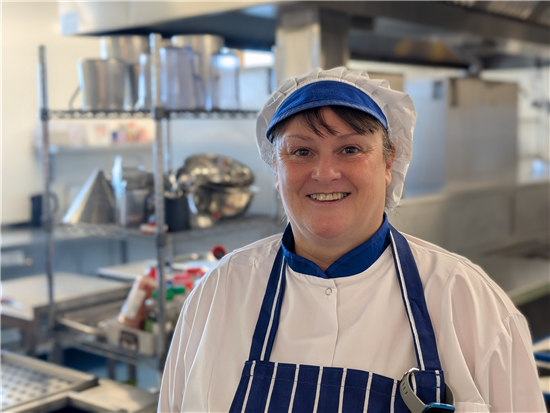
A Prestatyn cook is stirring up a school dining hall filled with healthy food, a dash of learning and many bowls full of smiles and laughter.
Cooking up 30 years of experience in the catering world this year, Carol McWilliams is busy creating tasty delights for the pupils of Ysgol Clawdd Offa.
County Voice dropped into the kitchen at the school to find out what inspirations are in Carol’s recipe book for progressing in catering and to find out the secret ingredients for a happy food fulfilled school of pupils.
Born in Manchester, Carol with her family moved to Rhyl when she was seven years old and 20 years ago she moved over to Prestatyn.
She said: “I did catering in college, I’d always worked in cafes part time. I worked in the Russel café in Rhyl, liked it, went to catering college at Coleg Llandrillo, did a course on hotel keeping and catering which is everything from making beds to cleaning toilets, right the way through to running a hotel.
“The Catering course covered all aspects of catering from cooking to waiting on and at that time I did prefer waiting on. After college I went to work down south to High Wycombe in a large conference centre, waiting on there."
The lure of home life soon tempted Carol back for a new slice of career and she travelled back to North Wales to work for a while for McDonalds to continue honing her trade.
Carol said: “Then I heard about school catering, went for it and I’ve been in this profession ever since… I’ve been 30 years in the service now and I love it."
Rewinding the school cooking timer to the start, Carol began at Ysgol Tremerchion looking after 60 pupils which she admits was a great training ground to get used to timings for preparing, cooking and serving the food for the children.
She then moved on to making sure the children of Ysgol Bryn Hedydd, Rhyl, were well fed and happy through the school terms for 17 years before moving to Ysgol y Llys and then arriving at Ysgol Clawdd Offa in 2017.
Looking back, Carol explained: “It’s a great way to start off and then you progress to a bigger school because you are given that opportunity here. The bosses are great, they encourage you into getting additional qualifications and if you want to move up and progress, you have that opportunity to move to a bigger school.”
Catering in schools also cooks up a good work life balance dish according to Carol for anyone with busy families be it humans or a loving home of animals.
She said: “It's just a great place to work, especially if you've got a family, not many people who work in catering can say they are off every school holiday. I get up early to feed all the animals because I’ve got four dogs, two birds, two snakes, two rabbits, crested gecko, tortoise, bearded dragon… I feed all those first!
“Then I have a coffee and I’m set for work and in for eight o’clock, I do all my morning food safety checks, set up the kitchen ready, looking at the menu, seeing what’s on for today, looking at what I can prep for tomorrow as well.”
Standing in the beating heart beat of the school kitchen facilities, Carol demonstrates how forward thinking her role is by showing how the prep is done for the day after’s lasagna on the menu with just the fresh sauce to do to go on top.
Thanks to the efforts of Carol and her team there’s always a feast of choice on offer to suit all young appetites each day as well as the main dish delights.
She explained: “There’s always a choice, there’s the two hot main courses, jacket potatoes with a choice of fillings and a selection of sandwiches. We also cater and prepare a selection of meals for the children with allergens, intolerances and special care needs to make sure they are catered for.”
The busy prep and cooking of catering is all worth it though as Carol admits seeing the children smile and laugh at lunchtimes lights up the catering team’s day.
“The Pupils are great, no two days are the same, every day we have a laugh at something they’ve either said or done but its always with them not at them… they are fabulous.”
Throughout the year at school the pupils have themed learning and Carol and her team have put their own thoughts and ideas together to carry the education and the fun into the school dining hall.
“We do theme days, we have one a month, we’ve just done the Chinese New Year in cooperation with one of the school's teachers, she very kindly brought in some Chinese decorations for me to use, I had some at home, so we decorated the serving counter to make it more fun for the pupils.
“On the menu that day we had chicken chow mein and spring rolls, along with chicken curry and rice and for dessert we did a golden crispy cake as well, it was lovely. The pupils loved it, especially seeing the counter decorated it makes it more special for them.”
Working in the school catering service also gives Carol and her colleagues the chance to input into how the daily school menus are designed across Denbighshire.
She explained: “The management team create the menu, we are due to change to a new 3-week menu starting from Easter. They work with the cooks and discuss what goes well and what changes can be made and take feedback on board before the nutritional content is then balanced and analised in line with Welsh Government Healthy Eating in School regulations. We’ve just been informed the new menu has gained Gold Accreditation approval from Welsh Local Government Association.”
To support healthy eating, along with all the main course choices, the catering team offers a selection of fruit, yoghurt and salad to go with the sandwiches and jacket potatoes.
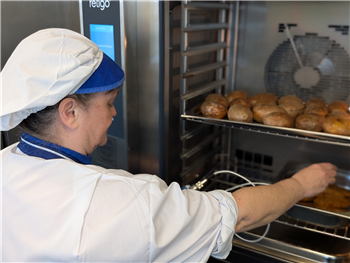
With the kitchen full of tempting smells, the big question is, what’s the dish of the day for Clawdd Offa pupils?
Smiling, Carol said: “They love the curry here, they love katsu curry because it’s a chicken goujon with a homemade katsu curry sauce and rice - it's lovely, very simple to make but really tasty and the pupils love it."
That’s something Year 6 pupil Ralph can confirm and who admits he’s a big fan of Carol and her team’s skills…especially when he’s hungry.
Ralph, a big fan of the catering team, let County Voice know: “The katsu curry, I love that. The staff are really nice as well, instead of making it a boring dinner they make it, so you are excited actually to go.”
Going back to the school cook’s 30 years of experience in the catering field and still cooking up delights for many youngsters, what’s Carol’s advice to anyone wanting to follow in her footsteps and develop with the support of the Catering Service.
Taking a second to think in her kitchen, Carol put forward: “It’s just having the love for people and food…and it’s having that passion to feed school children a choice of healthy, nutritious meals and encouraging them to try new things.“
Make your own mini meadow to help local nature
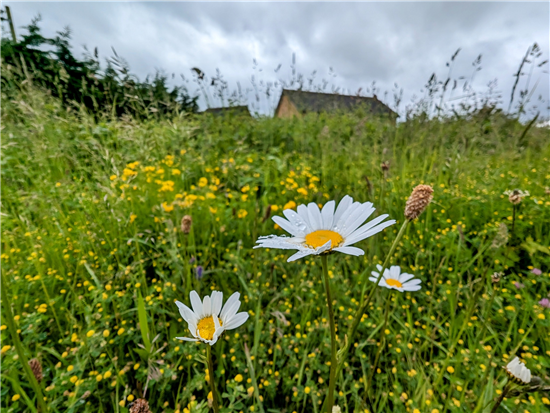
Did you know that it’s easy to give a helping hand to nature from your own back garden?
Preparations are in full swing for our 2026 Wildflower Meadows Project season. The project started in 2019 and includes approximately 70 acres of native wildflower habitat supporting local nature and also helping community wellbeing across the county. It has also been funded by Welsh Government, through the Local Places for Nature funding.
Residents can visit our meadows which are marked with the Bee Friendly sign, but those who want to do their bit from their home can also create their own mini meadow to support nature on their doorstep.
The first step is to decide the best place for your meadow on your garden area. Pick an area that isn’t too shady and where you are ok with leaving the grass long. You can pick the whole garden or just a patch and just simply let your chosen area grow.
During April, it’s the best time to make the decision to let your mini meadow grow as it is. Remember it takes time for a meadow to develop and it’s important to let it develop to see what it will produce.
Wildflowers that will thrive best in your meadow space are oxeye daisies, black knapweed and red campion.
Movement in your meadow will start appearing late May as the wildflowers begin to grow. As June arrives the actual flower can start to appear through your meadow.
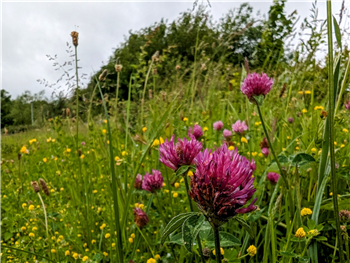
July is when your mini meadow will be at full strength supporting nature, it’s a great time to do a bug hunt through your area to see which insects are enjoying your creation.
As well as looking at what wildflowers you have blooming in your meadow, remember to look at all the different grasses. While we often focus on planting wildflowers for pollinators, many native grasses as just as important for caterpillars of butterflies and moth species.
August is a great time for your mini meadow as you will spot a slow change in what is flowering, with earlier species going to seed, and later species beginning to flower. Species that you might notice flowering at the end of the summer include black knapweed and yarrow, both of which are great for pollinators visiting your garden.
During August its also time to monitor when you need to cut your mini meadow. If you still have plenty of blooms you could leave it to September. You can also vary the cutting times across the year or the different parts of your own meadow depending on the size to make it more diverse for nature support. Cutting will help remove nutrients from the ground giving the wildflowers in the area the best chance to thrive.
Don’t forget to remove all the cuttings once their seeds have dropped and they have dried. A good tip as well is to keep your compost area as far away as your mini meadow to stop excess nutrients leaking back into the area and impacting on the growth of the wildflowers.
As September moves forward, it’s time to give your mini meadow a well-earned rest. You can leave the next cut until April or carry out several cuts to maintain the area if the winter weather stays mild. Before you shut down your mini meadow, take stock of what you have seen come through this season and the insects visiting the site as a record going forward for the next chapter of your own meadow.
Special storybook celebrates work to help rare bird
A special book is helping preserve a tale of important farming support for an under-threat bird
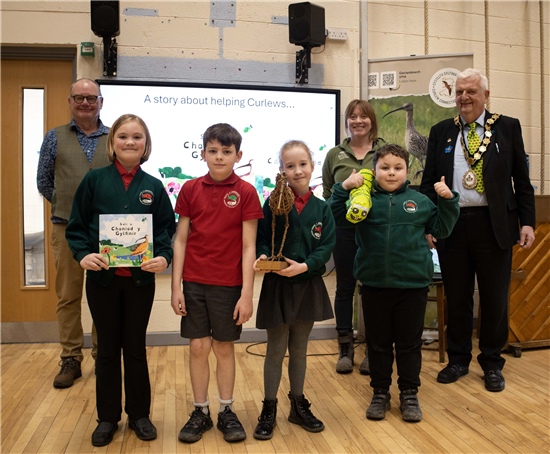
A special book is helping preserve a tale of important farming support for an under-threat bird.
For the past two years, the Clwydian Range and Dee Valley National Landscape has been part of “Curlew Connections Wales,” a Curlew Recovery Wales partnership project working alongside Bannau Brycheiniog and the Game & Wildlife Conservation Trust (GWCT).
The initiative formed part of the wider Gylfinir Cymru programme, an all-Wales partnership dedicated to supporting breeding Curlew populations across the country, including in Denbighshire.
Funding from the Welsh Government through the Heritage Lottery Fund is coming to a close for the project but the National Landscapes team will carry on working to protect the rare bird in their area.
Since running the programme has helped strengthen conditions needed for curlew recovery by improving habitat management, enhancing monitoring and data collection, increasing local capacity for ecological action and building strong, trust-based relationships with farmers.
To mark the huge community support given to the project, project staff worked with author Peter Evans to provide a timeless capture of the work and dedication seen to give hope to the curlew.
A book called Sali and the Call of the Curlew has been published which charts the seasonal journey of the curlew on farmland from the perspective of a little girl called Sali and her farmer Taid. Sali follows Pegi the curlew, who returns each Spring to the farm and both their journeys to the next breeding season.
Local Curlew and People Officer Sam Kenyon created the background to the story from her experiences and author and volunteer to the project Peter Evans brought her thoughts to life with help from pupils at Ysgol Caer Drewyn,Ysgol y Waun and Ysgol Bro Dyfrdwy, alongside storyteller Fiona Collins.
The book shows the plight of the curlew but with her Taid’s help, Sali finds out how small changes can make a big difference, and the pair set out to try to make sure more chicks survive the breeding season on the farm.

Primary school children from Ysgol Bro Elwern and Ysgol Betws Gwerful Goch also helped bring the storybook to life by colouring the illustrations created from collaged paper by talented Community Engagement Officer Jillian Howe.
The book is also designed to be accessible for those with Dyslexia thanks to the font used to tell the tale.
Receiving an official launch at Llangollen primary school Ysgol Gymraeg Y Gwernant with the support of Denbighshire County Council Chairman Cllr Arwel Roberts, English and Welsh copies will be made available to Denbighshire libraries and schools that have helped support the project over the last two years.
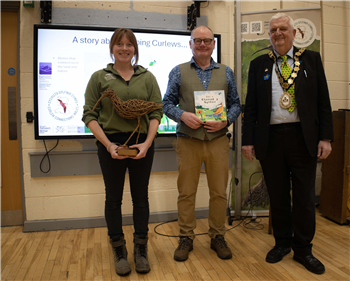
Local Curlew and People Officer Sam Kenyon, who has led the project for the past two seasons, explained the book is a celebration of the hard work from everyone who gave a supporting hand to helping the curlews and engaged with the wider programme over the two years.
“We wanted to do something special to celebrate the end of the project, especially following the amazing support we have had from the farmers, volunteers, schoolchildren and others who have played their part to give this bird a chance in our area. I’m so proud of the support that the farming community gave to our work, and I hope this tale highlights the commitment many can and do give to help the curlew.”
“For 2025, thanks to everyone’s combined efforts six chicks made it to fledging which was a boost to the local curlew population. It’s fitting we can celebrate the efforts by all the communities involved by leaving this book for the younger community members to read and learn how they and our rural communities can make a difference for the curlew.
“It’s humbling how everyone has come together to help the project, and I want to thank Peter and the school pupils for marking what a real positive journey this has been. But rest assured, the National Landscape won’t stop in the efforts needed to look after this amazing, rare bird and work will carry on as we move into the future to provide help to the iconic curlew.”
Josh’s Journey
Due to a relationship break down, Josh, who is 34, found himself seeking the Council’s homelessness team’s help at the start of last year. In February of 2025 Josh was placed in temporary accommodation and was assigned a homeless support practitioner.
 Josh
Josh
“I was homeless at the start of last year. I had been in homeless before and was placed in temporary accommodation previously, but I wasn’t in the right mindset previously to try and sort out my wider situation.
I was only in there briefly this time. I was asking everyone, trying to find a flat of my own. I eventually found one and moved out of temporary accommodation quite quickly.”
A month later, Josh had found himself privately rented accommodation to live in and was looking to write the chapter in his story.
“Whilst I was in temporary accommodation, my homeless support practitioner mentioned the intuitive thinking skills courses to me.
I was a little sceptical about doing the courses at first, but I didn’t realise until I sat them, that really, I had nothing to lose, and everything to gain from giving them a go.
I started the courses in April and March. I did the skills to life course first, which I really enjoyed and learned a lot from.
It teaches you how to deal with your own mindset, and how you think about problems. I used to really struggle with my confidence and doubt myself all the time.
They asked me at the start of the course what I would like to improve on, and so I put down work on my confidence.”
Josh then went on to take the Information, advice and guidance course, and dove deeper into his learning.
“I went on to do the Information, advice and guidance course, which taught me some more technical aspects. I would be put in other people's shoes, and I learned how to help those who may be more vulnerable.
I learned how to help others who may be in circumstances such as homelessness or maybe struggle with substance misuse.”
In early summer, Josh was offered an ambassador placement with the Intuitive Thinking team, with the hopes of that scheme then leading to a permanent job within the team itself.
“I was really buzzing as that was the placement I wanted the most out of the ones that were offered to me. I learned to give speeches and administer training by shadowing members of the team. That helped my confidence so much, standing up and speaking in front of people. I was terrified at first, but it got easier and easier over time.
I was about two months into my placement with the team when I got offered a job in the energy sector which I felt I just couldn't turn down.
The skills I learned during the courses I took, and my placement have given me so much confidence in my new role. This job is so different from what I’ve done previously, and these new skills have given me the confidence to go and try something new. That’s the main take away for me.
I was very much set in my ways of staying in my comfort zone before I did these courses. I would just do what I’d always done, but ultimately, I kept getting the same results. I feel like I spent years at a standstill really.
Since I’ve sat these courses, I’ve never felt better in my life. It sounds crazy to say that a course can change that, but I learned why I am thinking things and how to deal with those thoughts.”
Josh has chosen more positive ways to ways to pass the time.
“I have chosen more healthy options in life now, I struggled with boredom when I got sober about four years ago, I needed different outlets.
I started playing golf and going to the gym. I am now a member at Rhyl Golf Club.”
Josh has now graduated from the Intuitive thinking courses, with a number of certificates under his belt, and is enjoying his new role in the energy sector.
“I think these courses would benefit everyone; you don’t have to be in a bad position to take it. You can’t lose anything from learning from this course, as long as you are invested in it, you’re going to benefit from it.
People have said that they can see a change in my confidence. From where I was in February, to where I am now, it feels like two different people. I felt lost and had no hope really. It taught me to think differently and rationally think about situations. It has helped me to gain the focus and drive to get what I want.
It was like a snowball effect, as soon as I decided to start helping myself, things got gradually better.”
Restoring the Past, Building the Future: Nantclwyd y Dre
The site boasts nearly 600 years of local history and is one of the oldest timber-framed townhouses in Wales.
Ruthin is a town is steeped in history. Razed to the ground by Owain Glyndwr in the year 1400, the historic feel of the town as we know it today comes in large part from the timber-framed vernacular style of architecture which was used during the town’s reconstruction.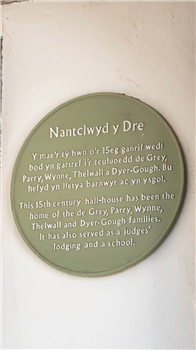
Among the charming streets and historic frontages sits an important piece of Ruthin’s built heritage. Originally built in 1435 as a weaver’s hall house, Nantclwyd y Dre boasts nearly 600 years of local history and is one of the oldest timber-framed townhouses in Wales open to the public.
Now managed by the Denbighshire Heritage Service, visitors to Nantclwyd y Dre historic house and gardens can relive the house’s fascinating past through immersive soundscapes, interiors and exhibits that give a captivating insight into what life was like for the families that lived there.
In 2023, funding was granted to restore parts of the site as the UK Government confirmed their intention to provide £10.95 million of grant funding for 10 capital projects aimed at protecting Ruthin’s unique heritage, wellbeing, and rural communities.
This funding, known as the Local Regeneration Fund (LRF), was awarded exclusively for successful projects included in Clwyd West and cannot be directed to other projects.
As one of the successful projects, £667,000 was allocated to redevelop some currently unused parts of the house in need of some repair to preserve this important piece of local heritage for generations to come, create new opportunities for the attraction to improve its future sustainability and make some exciting additions to the visitor experience.
Construction works began in October, focussing on bringing the largely unused west wing of the property back to life. This section of the house will become a small holiday let, designed and furnished in keeping with the historic nature of the building, and see improved facilities on the first floor with a dedicated space for the weekly volunteers who are a critical and valued part of the day-to-day workings at Nantclwyd.
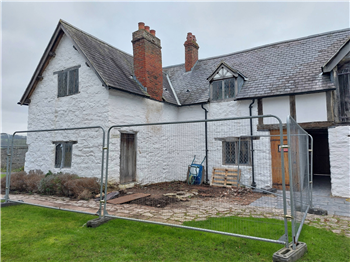
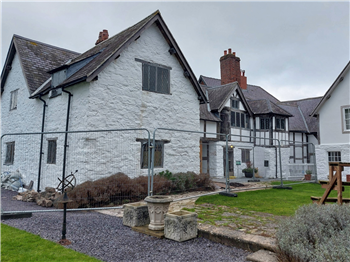
However, before the works could begin, one set of longstanding residents needed to be taking into consideration. Denbighshire County Council consulted with ecologists to ensure that the planned developments would not disturb the resident protected bat maternity roost, which houses a significant number of the Pipistrelle and Lesser-Horseshoe population in Wales. Contractors were given specialist training, and a large bat shelter was installed in the garden, giving the winged residents an additional space to thrive.
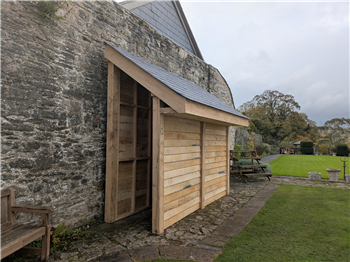 The planned improvements will also make the kitchen area more suitable for event catering, and the summerhouse will be restored to its former glory for visitors to enjoy during the summer months, also serving as an additional space for the ceremonies taking place at the historic house such as weddings and civil partnership ceremonies.
Undertaken by B&W builders & decorators alongside TACP Architects, the project is expected to be completed by April 2026. A more sustainable approach to the improvement works has also been implemented through using wool to insulate the building rather than the more widely used oil-based insulation which emits higher carbon emissions and isn’t renewable.
Councillor Jason McLellan, Leader and Lead Member for Economic Growth & Tackling Deprivation said:
“The beginning of these improvement works to Nantclwyd y Dre serves as a major milestone in securing the future of such a prominent historical site that sits at the heart of Ruthin.
“Nantclwyd is as a great visitor attraction and community hub for our dedicated volunteers, and we are looking forward to seeing the newly developed spaces being enjoyed and used by visitors.
“The wellbeing of the bat population will remain as a priority whilst the works are being carried out, and we will be in continuous communications with the ecologists throughout the completion of the works”.