FEATURES
Rhyl award winner grows hope for nature
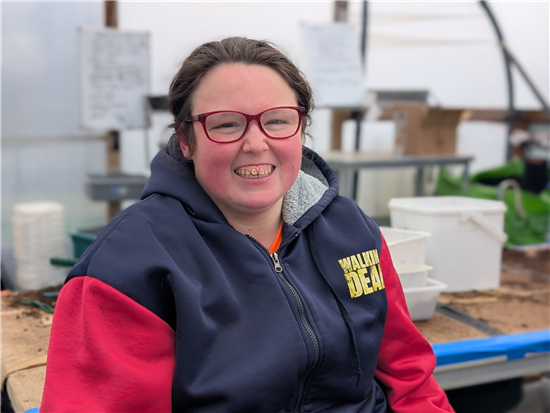
An award winning young passionate supporter of nature is giving a helping hand to growing a stronger future for Denbighshire’s plants and trees.
Ellie Hughes, of Rhyl, is one of a growing band of people joining a community of volunteers at the Council’s local provenance tree nursery at St Asaph.
Driven by a passion for all things nature, Ellie can be easily spotted at nature reserves across the north of the county, rolling up her sleeves to help countryside rangers with seasonal nature tasks.
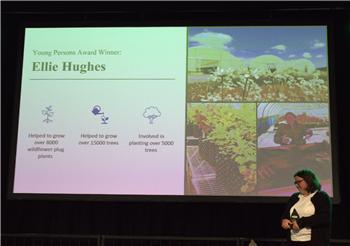
And with her love of the outdoors taking her to the tree nursery community, Ellie was also recently honoured by receiving the Bionet, the Nature Partnership for North East Wales Young Person award for 2025 for her dedication to helping her local nature.
County Voice caught up with Ellie whilst she was volunteering at the tree nursery to find out a little bit about her award-winning drive to support nature on her doorstep.
Ellie who studied at Coleg Cambria Northop and Coleg Llysfasi, joined the tree nursery community of volunteers in March last year and has become a regular each week, fitting it in alongside volunteering through Nature for Health to also help out on Denbighshire Countryside Service sites.
Remembering how she first came to find the nursery, Ellie said: “It was close by, and I was in college at the time and Wednesdays were my day off, my dad said why don’t you go there to volunteer.”
The tree nursery which grows local provenance trees and wildflowers from seed collected across the county provides a chance to develop new skills and learn more about nature due to it being situated on the Green Gates nature reserve which covers 70 acres of land.
Ellie explained: “I enjoy being outside helping nature and the healthy side of being outside. I like meeting the other volunteers and helping out here as it is a nature reserve and working in the poly tunnels and been with the trees all the time. “I’ve seen a robin come into the tunnels; I saw a grey squirrel the other day as well outside.”
Thanks to the support of staff on site and volunteer community, Ellie admits that coming to the tree nursery has also helped her learn and develop new skills.
She said: “I’ve learned many, I learnt how to sow seeds, to make things to help with the growing…. the tree planting out in the fields, I think I helped plant about a thousand. I get to know people, know what they do, what they do as a job, it’s quite cool. I get to learn from their own skills as well when they help me.
And what’s her words to anyone who maybe be interested in having a go at learning down at the tree nursery?
She added: “I’d say go for it; it’s a great opportunity learn great skills to maybe get a future job in work like this. The staff are both very nice, they are great to talk to, show me new skills and they help me understand more about what they do here.”
Sam Brown Tree Nursery Assistant said: “Ellie is such a joy to have down here and she amazes us each week with her commitment to helping out, learning new skills and developing her knowledge on our local nature in Denbighshire.
“She’s a big part of the fantastic community of volunteers we have at the tree nursery, and we are so proud of her for winning the Bionet Young Persons award as her passion for helping the project and what we have outdoors is just inspirational.”
If you would like to volunteer at the tree nursery please email with your details biodiversity@denbighshire.gov.uk
Josh’s Journey
Due to a relationship break down, Josh, who is 34, found himself seeking the Council’s homelessness team’s help at the start of last year. In February of 2025 Josh was placed in temporary accommodation and was assigned a homeless support practitioner.
 Josh
Josh
“I was homeless at the start of last year. I had been in homeless before and was placed in temporary accommodation previously, but I wasn’t in the right mindset previously to try and sort out my wider situation.
I was only in there briefly this time. I was asking everyone, trying to find a flat of my own. I eventually found one and moved out of temporary accommodation quite quickly.”
A month later, Josh had found himself privately rented accommodation to live in and was looking to write the chapter in his story.
“Whilst I was in temporary accommodation, my homeless support practitioner mentioned the intuitive thinking skills courses to me.
I was a little sceptical about doing the courses at first, but I didn’t realise until I sat them, that really, I had nothing to lose, and everything to gain from giving them a go.
I started the courses in April and March. I did the skills to life course first, which I really enjoyed and learned a lot from.
It teaches you how to deal with your own mindset, and how you think about problems. I used to really struggle with my confidence and doubt myself all the time.
They asked me at the start of the course what I would like to improve on, and so I put down work on my confidence.”
Josh then went on to take the Information, advice and guidance course, and dove deeper into his learning.
“I went on to do the Information, advice and guidance course, which taught me some more technical aspects. I would be put in other people's shoes, and I learned how to help those who may be more vulnerable.
I learned how to help others who may be in circumstances such as homelessness or maybe struggle with substance misuse.”
In early summer, Josh was offered an ambassador placement with the Intuitive Thinking team, with the hopes of that scheme then leading to a permanent job within the team itself.
“I was really buzzing as that was the placement I wanted the most out of the ones that were offered to me. I learned to give speeches and administer training by shadowing members of the team. That helped my confidence so much, standing up and speaking in front of people. I was terrified at first, but it got easier and easier over time.
I was about two months into my placement with the team when I got offered a job in the energy sector which I felt I just couldn't turn down.
The skills I learned during the courses I took, and my placement have given me so much confidence in my new role. This job is so different from what I’ve done previously, and these new skills have given me the confidence to go and try something new. That’s the main take away for me.
I was very much set in my ways of staying in my comfort zone before I did these courses. I would just do what I’d always done, but ultimately, I kept getting the same results. I feel like I spent years at a standstill really.
Since I’ve sat these courses, I’ve never felt better in my life. It sounds crazy to say that a course can change that, but I learned why I am thinking things and how to deal with those thoughts.”
Josh has chosen more positive ways to ways to pass the time.
“I have chosen more healthy options in life now, I struggled with boredom when I got sober about four years ago, I needed different outlets.
I started playing golf and going to the gym. I am now a member at Rhyl Golf Club.”
Josh has now graduated from the Intuitive thinking courses, with a number of certificates under his belt, and is enjoying his new role in the energy sector.
“I think these courses would benefit everyone; you don’t have to be in a bad position to take it. You can’t lose anything from learning from this course, as long as you are invested in it, you’re going to benefit from it.
People have said that they can see a change in my confidence. From where I was in February, to where I am now, it feels like two different people. I felt lost and had no hope really. It taught me to think differently and rationally think about situations. It has helped me to gain the focus and drive to get what I want.
It was like a snowball effect, as soon as I decided to start helping myself, things got gradually better.”
Nursery nurtures new knowledge for Prestatyn volunteer
A growing band of community volunteers are finding their nature knowledge is blooming thanks to supporting a project designed to help local biodiversity.
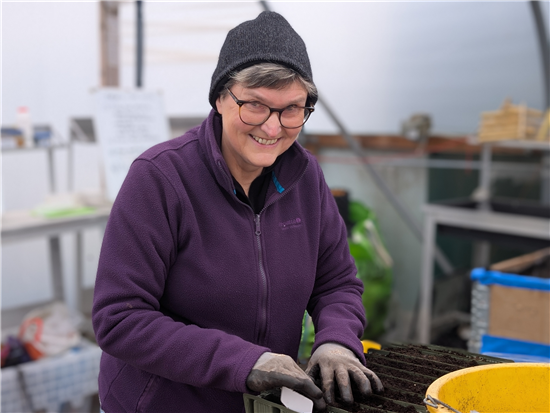
A growing band of community volunteers are finding their nature knowledge is blooming thanks to supporting a project designed to help local biodiversity.
The Council’s local provenance tree nursery at St Asaph is not just growing trees and plants found across Denbighshire, but also a strong community of volunteers who are nurturing new skills and knowledge thanks to visiting the site.
Janet Davidson, of Prestatyn, joined the community in June last year due to the strong social wellbeing aspect and flexibility that volunteering provides at the tree nursery.
She said: “I was new in the area, and I was looking for a volunteer activity that suited my personality as I’m not terribly a people person. I’ve always had an interest in horticulture and so this was ideal really. The times that are available for volunteers suited my needs so it all just seemed like a win-win really.
“It’s also really flexible so if you can’t make it one week, it’s very very easy going. “You get to do a variety of things which really does suit me. “
Becoming a member of the nursery’s community of volunteers has opened the door to new skills and knowledge for Janet who comes from a food manufacturing background.
“It’s like the use that trees are put to, the types, the varieties. For instance, I hadn’t appreciated the different terrains the two native oaks required. We have opportunities to learn each week here. There’s always something like learning about the black poplars, the challenges the team has tracking and making sure everything is traceable… that’s particularly interesting.”
The community of volunteers at the nursery are also bringing their own career skills to the site which is giving staff the chance to work with them to really shape the future of the nursery, explained Janet.
“Some elements are transposable from different industries, so traceability between food and trees, there are large chunks of it that are applicable. It all provides the team here another resource to bounce ideas around.
Turning to the new friends made at the tree nursery since last June, Janet added: “They are a very friendly bunch of people here and you feel it has a really good purpose to it and feels like it’s worthwhile.
“There’s usually a different crowd as not everyone can make it every week, you don’t know who is going to be here, but you know everybody that might be. That’s really good from a social point of view. There’s a real good diverse group of people that come and I think it’s better for that.”
Since blooming into life, the community of volunteers has become a staple fixture at the nursery grounds and they all enjoy rolling up their sleeves with the staff to make a difference for local biodiversity, Janet explained.
“Anything here is really a team effort. It’s not about individuals; it is about just chipping away, getting the stuff either in the pots or out of the pots or there’s quite a bit of maintenance stuff that you need to be prepared to do if you are here.
“You can’t expect to be planting oak trees every week, but when you do it’s a privilege, it is quite satisfying, I think it’s rewarding just turning up here. The team will direct us to what the week's activities are, and you just crack on then, and it is also nice and informal, and I really like that.”
Janet added: “Coming here you just feel better for it, I recommend it really, it’s no strings attached as well so you can come and do your thing and have a really nice time and then go and come next week and not have any stress associated with it.”
If you would like to volunteer at the tree nursery, please email with your details biodiversity@denbighshire.gov.uk
Restoring the Past, Building the Future: Nantclwyd y Dre
The site boasts nearly 600 years of local history and is one of the oldest timber-framed townhouses in Wales.
Ruthin is a town is steeped in history. Razed to the ground by Owain Glyndwr in the year 1400, the historic feel of the town as we know it today comes in large part from the timber-framed vernacular style of architecture which was used during the town’s reconstruction.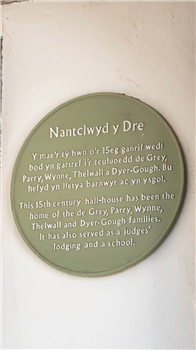
Among the charming streets and historic frontages sits an important piece of Ruthin’s built heritage. Originally built in 1435 as a weaver’s hall house, Nantclwyd y Dre boasts nearly 600 years of local history and is one of the oldest timber-framed townhouses in Wales open to the public.
Now managed by the Denbighshire Heritage Service, visitors to Nantclwyd y Dre historic house and gardens can relive the house’s fascinating past through immersive soundscapes, interiors and exhibits that give a captivating insight into what life was like for the families that lived there.
In 2023, funding was granted to restore parts of the site as the UK Government confirmed their intention to provide £10.95 million of grant funding for 10 capital projects aimed at protecting Ruthin’s unique heritage, wellbeing, and rural communities.
This funding, known as the Local Regeneration Fund (LRF), was awarded exclusively for successful projects included in Clwyd West and cannot be directed to other projects.
As one of the successful projects, £667,000 was allocated to redevelop some currently unused parts of the house in need of some repair to preserve this important piece of local heritage for generations to come, create new opportunities for the attraction to improve its future sustainability and make some exciting additions to the visitor experience.
Construction works began in October, focussing on bringing the largely unused west wing of the property back to life. This section of the house will become a small holiday let, designed and furnished in keeping with the historic nature of the building, and see improved facilities on the first floor with a dedicated space for the weekly volunteers who are a critical and valued part of the day-to-day workings at Nantclwyd.
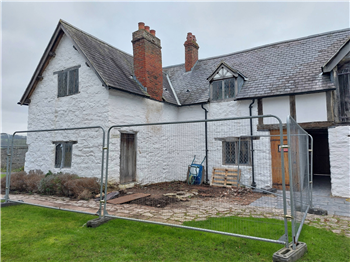
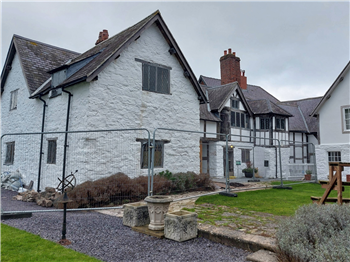
However, before the works could begin, one set of longstanding residents needed to be taking into consideration. Denbighshire County Council consulted with ecologists to ensure that the planned developments would not disturb the resident protected bat maternity roost, which houses a significant number of the Pipistrelle and Lesser-Horseshoe population in Wales. Contractors were given specialist training, and a large bat shelter was installed in the garden, giving the winged residents an additional space to thrive.
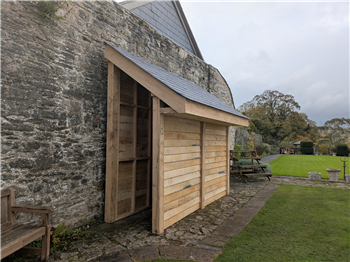 The planned improvements will also make the kitchen area more suitable for event catering, and the summerhouse will be restored to its former glory for visitors to enjoy during the summer months, also serving as an additional space for the ceremonies taking place at the historic house such as weddings and civil partnership ceremonies.
Undertaken by B&W builders & decorators alongside TACP Architects, the project is expected to be completed by April 2026. A more sustainable approach to the improvement works has also been implemented through using wool to insulate the building rather than the more widely used oil-based insulation which emits higher carbon emissions and isn’t renewable.
Councillor Jason McLellan, Leader and Lead Member for Economic Growth & Tackling Deprivation said:
“The beginning of these improvement works to Nantclwyd y Dre serves as a major milestone in securing the future of such a prominent historical site that sits at the heart of Ruthin.
“Nantclwyd is as a great visitor attraction and community hub for our dedicated volunteers, and we are looking forward to seeing the newly developed spaces being enjoyed and used by visitors.
“The wellbeing of the bat population will remain as a priority whilst the works are being carried out, and we will be in continuous communications with the ecologists throughout the completion of the works”.
Career change for St Asaph man helps build continued support for frontline service
A career change with help from a council scheme has inspired a St Asaph man into stepping forward to help make a difference for local Denbighshire communities

A career change with help from a council scheme has inspired a St Asaph man into stepping forward to help make a difference for local Denbighshire communities and the county environment.
County Voice sat down recently with Waste and Recycling Relief Team Leader Owen Lokier to find out how a decision to jump career tracks has helped gather knowledge and experience in the service on a professional and personal level.
Owen said: “Originally I was an engineer; I worked in the steel industry as a fabricator and welder and just basically fancied a change in career
“In January 2022 I saw an advert for the Working Denbighshire scheme for refuse collectors, so I decided I’d go and give that a shot. I started that in the January, it was a three-month scheme based in Ruthin, and off the back of that I ended up landing a full-time contract with the council as a refuse loader. The Working Denbighshire scheme was definitely a positive for this.”
Operating as a loader for 12 months, an opportunity came for Owen to expand his skills in the service.
“My line manager gave me the opportunity to drive our smaller cage vehicles a couple of days a week. This was mainly driving up to the farms, rural areas. It was based in the south, from Trefnant all the way down to Llangollen, it gave me an insight into the driving side of the service. “
The wheels of progression in the service did not stop there for Owen as spurred on by operating the smaller class of vehicle, he decided to go and do the class two LGV licence through a Welsh Government backed scheme.
“This gave me the opportunity to progress into the role of a full time driver that came available. So, I had worked my way with Working Denbighshire’s help to a grade two loader, to a grade four driving a smaller cage vehicle and then with my LGV licence I became a grade five.
“That was where I was up to until we came to Denbigh in June 2024, I was what you would call a floater at the site, I’d cover lads on sickness and one of the benefits to that was I was able to learn a lot of different rounds across the county which gave me s lot of knowledge.
“It came with its challenges as one day you could be doing something and the next day something completely different, but I liked the variety of it and also working with different teams.”
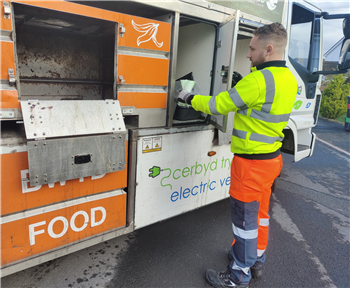
Getting to meet a lot of the service workforce helped Owen into a position to use his experience to support the service even stronger as in November 2024 he alongside another colleague was successful in applying for two relief team leader posts that help cover sickness and annual leave management from the office.
Waste and Recycling staff can also access training opportunities and whilst carrying out his current role, Owen is also working towards more qualifications with the support of Cambrian Training.
He explained: “I enrolled on a Level 3 Diploma for Sustainable Recycling Activities (Supervisory) course which I’m currently studying for. I’m hoping to progress as well from this to a level 4 NVQ to keep working my way up.
“Bev from Cambrian is very helpful, she understands that learners have different ways of learning, I like to have a bit freer rein doing the coursework, we meet once a month and I will go away and try to do a lot of it in my own time.”
Changing careers to make a difference to the local environment by helping residents with their recycling and waste, also means a lot more time engaging with county communities according to Owen.
He said: “I enjoy working outdoors and I enjoy engaging with the public which is quite a big one because you do have some positive and also some negative engagement, but I always try to turn the negatives into a positive.
“One thing I’ve always said is refuse collectors they are a part of the council that everyone in the public sees every week of their lives.
“If someone’s’ got a problem with the pavements, with the roads, we do hear that and we always try to turn it into a positive and a lot of positives do come out of it, especially around this time of year at Christmas and New Year when you look at the lads and how grateful the public are for them being out there in all weathers 52 weeks of the year.
“Also, for the elder community the refuse collectors might be the only person bar the postman that they may see in the week, so when I was on the rounds I’d try to take a couple of minutes just to say hello, how are you. That goes a long way for them as well.
He added: “Overall, as a career it’s great, it’s working outdoors, good for the environment as well.”
And what is Owen’s advice to someone who is considering a track change into the service?
He said: “I think the council is a great authority to work for. You get out of it what you put in. So, if you show you’re enthusiastic, flexible and willing to help others out that’s a great help. Teamwork, that’s a massive factor in this line of work…just don’t stop, show the willingness to learn and keep having your goals.”
Brickfield’s best for birds
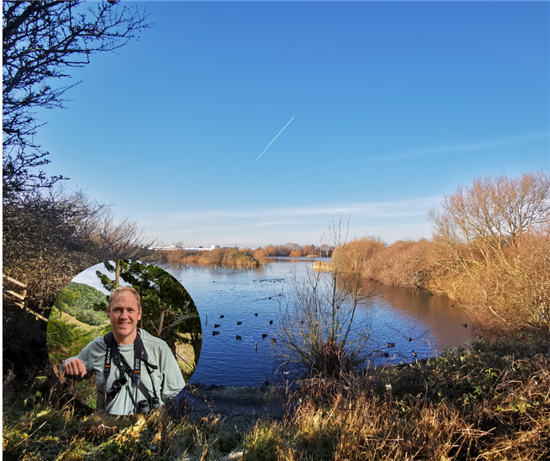
A Rhyl nature reserve is providing a haven for all varieties of birds according to an experienced local birdwatcher.
For well over a decade, Alex Humphreys Jones, originally from St Asaph, has been tracking the comings and goings of bird species at Brickfield Pond Nature Reserve. Managed by Denbighshire’s Countryside Service, Alex has found the site to be a haven for over 100 different species during his visits the reserve.
County Voice sat down with Alex to find out his visits to Brickfield and how work by countryside rangers and volunteers has helped create a great environment for some notable feathered guests.
Is birdwatching one of your hobbies, if so what do you enjoy about it?
Birdwatching is a huge passion of mine and it plays a part in my life every day. I enjoy birdwatching on a local, national and worldwide scale. This is a hobby that has taken me across the country and around the world. Birdwatching comes with its various levels of difficulty from identifying a species to finding your own rarity and I enjoy all aspects.
How many years and how often do you come down to Brickfield Pond?
I have been coming down to the Brickfield Pond since 2013 after identifying the site as a thriving area for birds and wildlife. It's also an easy site to access and fits around my work commitments where I can incidentally come down and walk around all within 30 minutes. I aim to get down at least a couple of times a week but this can vary on season.
Have you noticed an increase in species numbers, if so from when?
I use an online bird recording app called BirdTrack which is a free platform for birdwatchers in Britain to log their sightings. BirdTrack helps form a list and produces tables and graphs with my bird data. Since visiting the Brickfield ponds, I have recorded 112 different bird species with 4 new species seen in 2025 (the first new species for me since 2022).
How many have you recorded for 2025 and what's the most notable ones you have seen at the site?
This year (2025), I have recorded 78 species at the Brickfield Pond with Goshawk, Woodcock, Spotted Flycatcher and Red Kite being notable for the site. Back in June, the Brickfield Pond hosted a Black-crowned Night Heron which proved to be the first record of this species in North Wales since 1993.
The Brickfield Pond is essential for many waterbird species such as Great Crested Grebe, Kingfisher, Goosander and Tufted Duck, however it is just as important for migrant birds on passage. It has been known to be one of the first sites to record Sand Martin in North Wales in Spring and remarkably record 4 Yellow-browed Warblers (a scarce North Wales vagrant) from Siberia over the last 10 years in autumn. Cetti's Warbler use to be absent from North Wales, however the Brickfield Pond was one of the first sites to record one in Denbighshire and in recent years, it is believed that they have colonised and bred.
Over the years, I have found some notable records locally such as Firecrest (Dec 2015), Waxwings (Dec 2016), Slavonian Grebe (Nov 2018), 3 Yellow-browed Warblers (2016, 2018, 2019) and a long-staying Iceland Gull (Jan-Apr 2021).
Lastly – what’s your favourite bird species?
This is a really difficult question as there are so many species to choose from however, I particularly like a group of birds otherwise known as hirundines/swifts. In Britain, we know them as Swallows, House Martins and Swifts - all known for their vast migrations and their powerful, acrobatic flight.
Countryside ranger Vitor Evora, who helps manage Brickfield Pond, said: “It’s great to know that people like Alex are getting so much enjoyment out of the reserve and even better to see that the site is really giving a helping hand to all kinds of bird species through the seasons.
“We’ve worked hard to develop the site both for visitors and wildlife, and we hope that bird numbers will continue to be strong, providing a great place for birdwatchers young and old to visit.”
Advice for residents – what to do before, during and after flooding
Denbighshire County Council is reminding residents to stay alert and take practical steps to protect themselves, their homes, and their communities in the event of flooding during the winter season.
County Voice has prepared a rundown of advice to help residents be on the front foot against the impact of any flooding across Denbighshire.
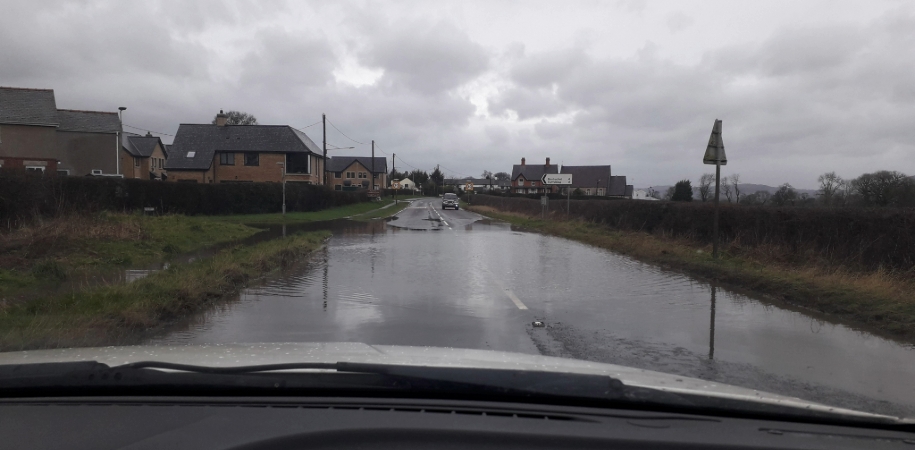
As we see more storms hit the county, flooding can happen quickly and with little warning. Being prepared before, during and after a flood can make a significant difference to safety and recovery after the event.
To prepare for potential flooding you can:
- Check your flood risk: Visit the Natural Resources Wales long-term flood risk maps to see if your property is in a flood risk area.
- Sign up for warnings: If you are at risk, sign up for automated flood warnings to get alerts as soon as possible.
- Review your insurance: Ensure your home and contents insurance includes flood cover. The Government and insurers’ initiative Flood Re can help make flood insurance more affordable.
- Make a personal flood plan: Include key contact details, insurance information, and a checklist of emergency actions. Store it safely in a waterproof folder.
- Prepare a flood kit: Include warm, waterproof clothing, medication, a torch, important documents, and essential supplies in case you need to evacuate.
- Consider protection products: Purchase sandbags or flood boards to block doorways and airbricks.
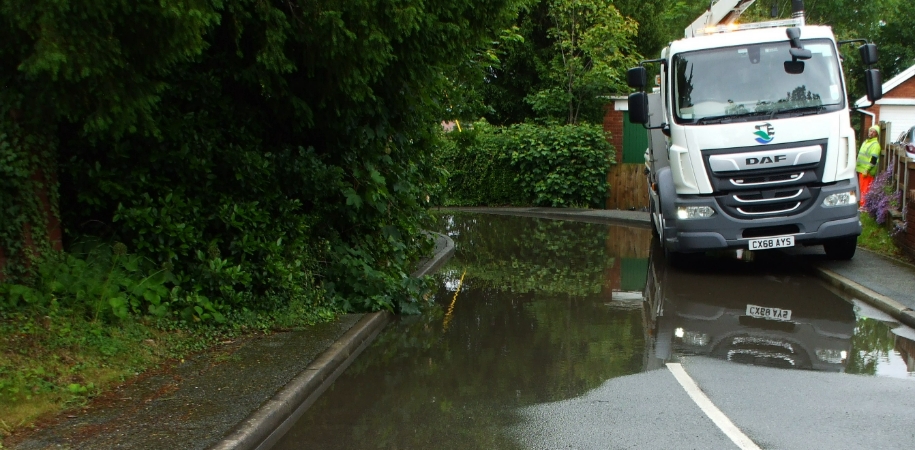
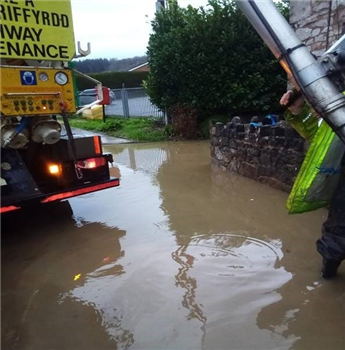 If flooding does happen following adverse weather and there is a flooded road or a blocked ditch in your area, let the Council know and we will take action to bring the problem under control.
Natural Resources Wales are responsible for issues involving coasts and major rivers. Welsh Water are responsible for sewers. Denbighshire County Council are responsible for surface water and small water courses.
For issues involving major rivers, please contact Natural Resources Wales on 0300 065 3000.
Please see this link below for details of major rivers
For flooding affecting sewers, including combined foul and surface water sewers , please contact Welsh Water on 0800 085 3968 or
For flooding to property or highways, contact Denbighshire County Council on 01824 706000.
Concerns over flooding in your area can also be made to Floodline on 0345 988 1188
If you live in a flood risk area and feel you would like to have a few sandbags at home to keep as a precaution to use in the event of a flood, you can buy sandbags from hardware or DIY stores. There are also other bespoke systems available to protect doorways and air bricks.
The Council does not provide sandbags to individual properties when there is a flood. Instead, we use sandbags mainly to protect groups of residents, for example by diverting the path of flowing water, and directing it towards gullies and manholes. This enables us to protect whole streets, whereas giving out sandbags to individual householders in a street would be a far less effective use of resources.
Communities can also work together to help local residents become more resilient to flooding.
Dyserth Flood Support Community Group was set up after historic flooding on Waterfall Road. The Council provided flood barriers through help from a Welsh Government grant, the funding criteria of which being they could only provide to a community group. Denbighshire County Council provided additional barriers in 2025.
Advice in setting up a local community flood action group is available from The National Flood Forum or contact Paul Owen on 01824 706872 / paul.owen@denbighshire.gov.uk
When a flood happens don't try to walk or drive through flood water. Six inches of fast flowing water can knock you off your feet, and two feet of water will float your car. There are a number of practical things you can do to help prevent damage to your home, including:
- Turn off your gas, electricity and water supplies
- Put plugs in sinks and weigh them down with heavy objects; plug water inlet pipes with towels or cloths, and disconnect any equipment that uses water, such as your washing machine. These steps will help to stop water from coming into the property
- Try to avoid contact with flood water if possible, because it may be contaminated
- Do not leave your home or enter flood water unless you are directly instructed to do so by the emergency services
Councillor Barry Mellor, Cabinet Lead Member for Highways and the Environment, said: “We will always work very closely with our partner agencies to do all we can to minimise the impact of any flooding events that occur across the county. We want our residents to stay safe and I would ask them to follow this important advice to prepare for potential flooding and if it does flood in your area please follow any information issued by us, Natural Resources Wales or the emergency services and also ask people to keep an eye on the weather forecasts, the media and social media for the latest advice and information”.
You can follow us on Facebook to get updates during a flood event
For further information visit our flood advice web page.
Ever wondered where your Council tax goes?
Many people think that Council tax pays for everything that a local authority delivers, however, the money collected from residents annually only accounts for 26% of total Council spending.
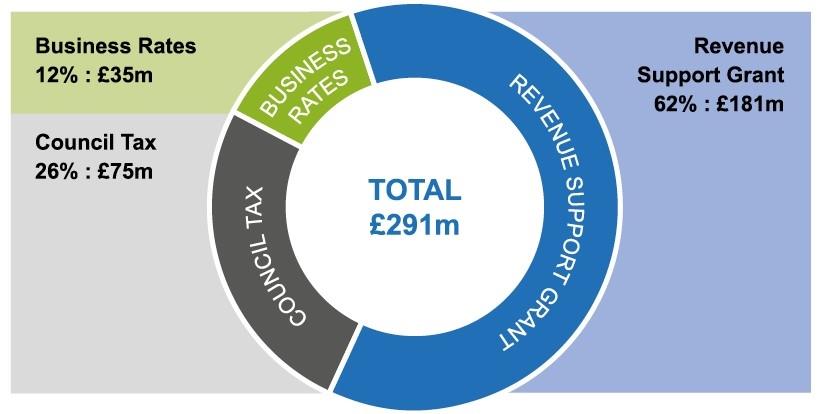 The majority of funding (62%) comes in the form of a ‘Revenue Support Grant’ from Welsh Government, while the remaining 12% comes from business rates which is a property tax that businesses pay to help fund local services. You can find out more about how the Council is funded on our website.
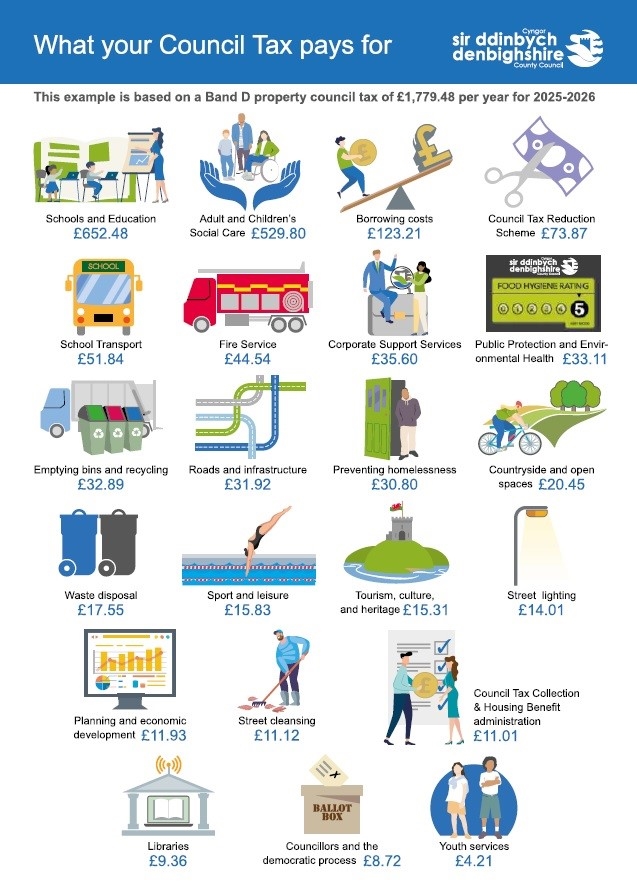
So where does your Council tax actually go? We’ve produced an infographic based on a Band D property council tax bill to help give a clear explanation of how council tax payments are used to fund the range of services for residents in the county. While this infographic gives a picture of how the money is shared between different services, understanding what residents gets for that money is really important.
As you can see, the majority of council tax spending goes towards protecting the most vulnerable in our society, with 66% spent on schools and education and adult and children’s social care.
 With Education accounting for 36.7%, it means that Denbighshire can educate approximately 16,500 pupils in 44 primary schools, 2 all-through schools, 2 special schools, 6 secondary schools and 1 pupil referral unit across the county, with approximately 780 teachers delivering this education
Still in the field of education, school transport accounts for 2.9% for which the Council transports approximately 2,871 learners safely to schools throughout the county. In total, there are 650 school bus and taxi trips every school day.
 Meanwhile, adult and children’s social care accounts for 29.8% of Council tax spending. For this, in 2024-2025, an average of 668 members of staff had over 25,000 contacts with the most vulnerable children and adults and provided a package of care and support where necessary giving these residents the opportunity to exercise choice, voice and control over their lives.
In other service areas, 1.9% goes towards public protection and environmental health and the Council’s teams inspects approximately 720 restaurants, cafes and take aways every year to ensure they’re operating safely for the residents of Denbighshire.
 Emptying bins and recycling accounts for 1.8% of your council tax bill, which equates to £32.89 per year (based on a Band D property). That involves collecting around 73,000 containers from over 47,000 households every week across the county.
For 1.8% of council tax, we maintain 1,419km of carriageways (excluding trunk roads), 601 highway bridges and culverts, 302 retaining walls and 26,000 gullies. And for 0.8%, we maintain 11,763 street lights and 1,547 illuminated signs and bollards throughout the county.
 Other services residents may not be aware that are delivered by the Council are the Countryside and Heritage Services. With 1.1% of council tax going to the countryside service, the teams manage over 80 sites and more than 1,200 hectares of public green for both recreation and conservation. These range from the Country Parks of Loggerheads and Moel Famau, the county tree nursery at St. Asaph, Brickfield Pond in Rhyl, Prestatyn Dyserth Way, Llantysilio Green in the Dee Valley and numerous smaller amenity community spaces across the county.
While the heritage service accounts for 0.9% of Council tax spending and for this, the service preserves and promotes the county’s unique history, caring for important historic sites including Ruthin Gaol, Plas Newydd, Nantclwyd Y Dre, Rhyl Museum (based in the library) and a large collection store. This work ensures Denbighshire’s rich history remains accessible for education, wellbeing, and enjoyment.
Planning and economic development accounts for 0.7% of Council tax spending and for that the Local Planning Authority processes around 1,000 planning applications each year alongside 10-20 appeals and 50-100 pre-application enquiries. We also respond to over 500 planning compliance cases.
 Libraries account for 0.5% of Council tax spending and in 24-25, Libraries delivered 514 Bookstart sessions to nearly 6,500 children for this money. It also lent 2,869 audiobooks to 1,028 library members on Borrowbox (part of the Digital Offer) and printed over 56,000 pages on public access printers.
Not all Council tax collected pays for council services, 2.5% goes towards the Fire service to contribute to the funding of fire protection and prevention across the county.
Councillor Delyth Jones, Lead Member for Finance at Denbighshire County Council said, “I am pleased to see the production and release of this infographic information. It will, I hope, provide residents with the context they need in order to understand how their council tax payments are used to support the breadth of services delivered by the Council.
“In what is a continuing financially challenging climate, I think it’s important to be open and clear about the costs and the pressures. It’s also important to emphasise that many of the aspects of expenditure are, quite rightly, aimed towards the legal requirement to provide Adult Social Care, Children’s Services, and Education etc. These are the areas that support the most vulnerable in our society.”