23/11/2026
From local seeds to a greener future: St Asaph’s tree nursery
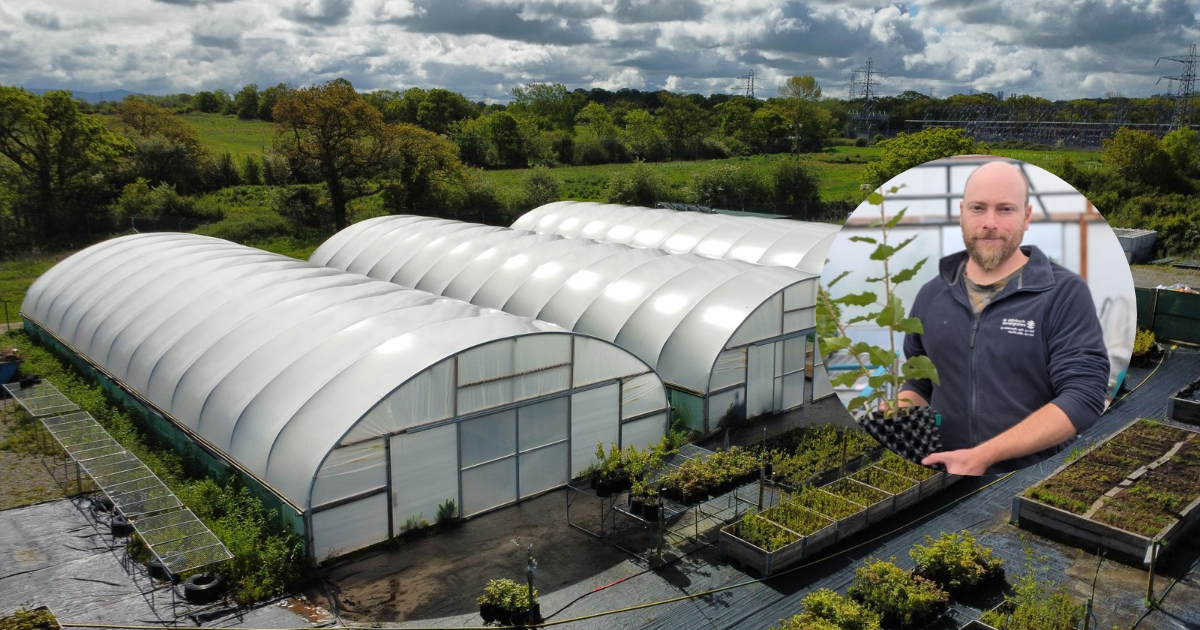
To mark National Tree Week, Keegan Blazey, Tree Nursery Officer, writes for County Voice about the role of Denbighshire County Council’s tree nursery at St Asaph. He explores how growing native trees from locally collected seeds can support biodiversity, capture carbon and help create a greener future for the county.
The Denbighshire County Council Tree Nursery collects local provenance seed from within Denbighshire and grows them on with the intention of bolstering biodiversity and carbon capture within our environment. To celebrate National Tree Week, we have put together this little article to put into perspective what our Nursery is in theory able to achieve.
Annually we can grow around 40000 handpicked native trees of high conservation value which have genetically adapted to our local area over thousands of years.
Trees in general have many ecosystem services, some mentioned by NRW are:
- help protect the quality of drinking water supplies (Regulatory)
- help manage flood events (Regulatory)
- capture harmful pollutants and improve air quality (Regulatory)
- provide shade, shelter, temperature regulation and absorb sound (provisioning)
- stabilize soils, reducing erosion and landslides (regulatory)
Without trees providing these valuable ecosystem services we will be forced to artificially provide them ourselves, for example flood defences. During the severe heat waves experienced this year, I don’t think anyone would question the value of an urban tree providing shade, or a grove of cool Oak trees allowing cool air to flow into your home. Therefore, we need our natural habitat and biodiversity to remain intact, otherwise who will clean and regulate our air, water and soil?
In addition to these practical services that trees provide, they also provide biodiversity value,
for example, habitat for mammals’ birds, invertebrates and plants. In turn, all these wonderful creatures provide their own practical ecosystem services to us, for example bats are excellent at keeping the midge population to a manageable level. Without the trees these wonderful creatures have limited options on where to live.
Because we grow only local provenance native trees, the invertebrate, mammal and bird species that can be supported by our trees is far greater than non-native trees. For example, Oak is known to support a staggering 2300 species when it is mature, by comparison Sweet Chestnut which is a naturalized non-native tree only supports 11.
Growing trees is only half the struggle, the next part is planting them somewhere meaningful.
A piece of land is officially classed as woodland if it reaches 20% canopy cover, which works out to 100 trees per hectare. This means that our nursery can theoretically fill 400 hectares (40000 divided by 100) per year. To put this into context, 20% canopy cover is not a dense woodland, London city is estimated to be 19.6% canopy cover (https://www.london.gov.uk/who-we-are/what-london-assembly-does/london-assembly-research-unit-publications/tree-canopy-cover-london) and this is the lowest recommended canopy cover in the UK.
By planting a 100 tree per hectare forest (20%) canopy cover using the tree mix that we grow at our nursery (Oak, Birch, Willow, Alder, Poplars, Crab Apples, Rowans, Hazel, Hawthorn etc) we estimate that we are doing the following:
- Supporting over 2300 distinct species of insects, mammals, birds, plants, lichens, fungi. Biodiversity doesn’t stack, but the supporting trees to Oak will provide resilience encase there is a disease or disturbance that kills off the oak. They also provide food sources and structural habitat at different levels and times of year for biodiversity.
- Trees intercept rainfall in their canopies (reducing ground-reach by up to 45%) and their root systems dramatically increase soil infiltration, reducing surface runoff by 99% compared to tarmac or concrete.
- Currently saving around 8 tonnes of CO2 over 100 years.
- Native broadleaf trees trap particulate matter and absorb noxious gasses like Nitrogen dioxide (from cars). preventing respiratory illness and reducing NHS burden.
Welsh Government aims to plant 43000 hectares of new woodland by 2030 to assist with net-zero carbon goals. This year only 680 hectares of new woodland were created. This is less than 10% of the target. It’s a difficult task finding space for trees in the UK, despite their myriad of benefits and it’s equally hard to establish trees after planting them. This is where community nurseries can step in and begin to make a small difference towards these goals on a community level.
What canopy cover does your town or village have? Are there spaces that can take trees?
Do you know someone somewhere that needs 20% canopy cover
I hope you have enjoyed this article, which strives to put into perspective the value of trees, please keep in mind that this is theoretical and in reality, planting a tree is not as simple as it sounds.